

[ad_1]
For decades, Hollywood has experimented with technology to make movies and TV shows faster, cheaper, and flashier. Now, with generative AI, that experimentation is creeping into one of the industry’s most sacred spaces: the writers’ room.
From blockbuster franchises to indie productions, writers are grappling with AI’s role in shaping scripts — sparking fierce divisions among industry insiders. Some see it as a tool that could add depth to the storytelling process. Others see it as a soulless machine, incapable of capturing the lived experiences that make great stories resonate.
Studios like Lionsgate are already striking deals with AI startups to speed up production and cut costs. Meanwhile, the Writers Guild of America has staged protests against the technology, waving signs that say “ChatGPT doesn’t have childhood trauma.”
Audiences may also be wary: A recent survey of 5,000 people across the US, UK, Europe, and Australia by Baringa, a management consulting firm, found that 53% of US consumers would feel uncomfortable watching content touched by AI. Despite some startups’ cautious approach, the usage of AI raises legal and existential questions about what stories get told, who gets to tell them, and how audiences will connect with the next era of entertainment.
Still, there’s been a wave of experimentation, like using AI to predict the likelihood of a script’s box-office fate and filmmakers treating it as a tool for rote parts of script writing.
Startups are using AI to transform the screenwriting process
Some companies see AI as a way to place safer bets on risky projects.
Largo.ai, a Swiss startup, uses predictive AI to analyze screenplays and forecast their commercial potential. Studios can upload anything from a synopsis to a finished cut, and the system maps plot, genre shifts, emotional arcs, casting, and audience and financial predictions.
Once the screenplay is uploaded, the AI compares its elements to a database of 400,000 films, featuring data on the successes, failures, and narrative components of past Hollywood and indie films. The AI also runs simulated focus groups with “digital twins” that represent real consumers.
Largo then generates detailed insights on genre trends, audience demographics, and revenue forecasts. Studios can later use these insights to decide which projects to greenlight and to guide rewrites. If a story’s emotional arc reads as “too flat,” for example, that feedback can be relayed to writers.
According to the company, producers using its software have a green-lighting rate of three times higher than average. The company also said simulated focus groups are 10 times faster and cheaper than traditional ones, giving smaller studios access to testing once reserved for big-budget productions.
“The goal is not just to increase commercial value, but to use the feedback to increase creative value as well,” Sami Arpa, the CEO and cofounder of Largo.ai, told Business Insider.
Filmmakers are experimenting with AI as a creative collaborator
Filmmaker Nik Kleverov used ChatGPT on “Memory Maker,” a sci-fi short he directed for AI film studio Wonder Studios. He used the chatbot to check story originality, brainstorm plot twists, and expand the project’s fictional universe.
But Kleverov rejects letting AI draft full scripts, calling the “regurgitated” results “stale” and “trite.” At the same time, he sees it as a way to explore big, budget-impacting ideas without costly risk.
“As far as original creativity, the human mind is unparalleled,” Kleverov told Business Insider. “Humans always need to lead those stories.”
For some creators, AI can spark inspiration in unexpected ways.
Rahul Gautama, EY’s media and entertainment consulting leader in the Americas, recalls an animator client who tested prompt-based image generation and received a “hallucinated” image that inspired a new narrative direction. It’s an example of how AI-image generators — even if they don’t work as intended — can inspire fresh ideas.
“Script visualization is an exciting space,” Gautama told Business Insider. “Providing writers an opportunity to ‘see’ their ideas before filming can offer valuable creative provocation.”
AI creates new forms of storytelling — but with limits
Some filmmakers are using AI to reimagine how stories are told.
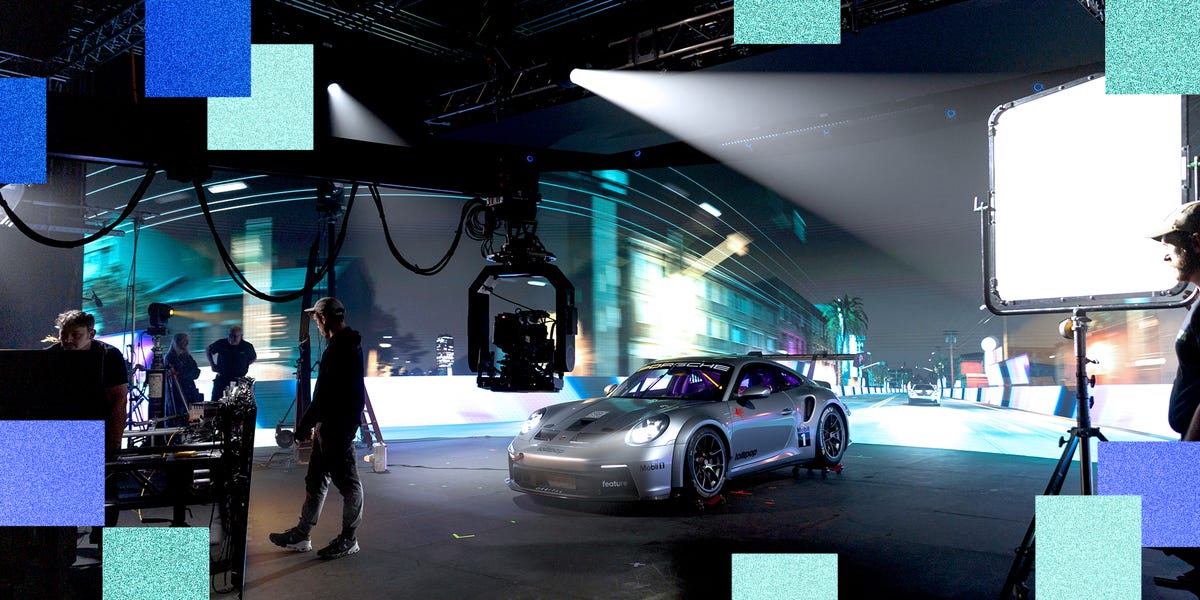
Steven Ilous, the founder and CEO of Feature.io, an entertainment technology startup, works with clients like Netflix and Porsche to make “Smart Content” that blends narrative with audience engagement.
In “Lollipop Racing,” a 10-episode series with “The Fast and the Furious” writer David Ayer as executive producer, viewers can participate in a parallel race. Feature.io’s proprietary AI creates digital avatars of the viewer, which are woven back into the show — sometimes even using their own voices. While the main plot remains human-written, Feature.io’s algorithm delivers dynamic, personalized content, like bonus scenes based on audience choices.
Ilous imagines AI enabling “never-ending” shows or fan-built universes. However, despite its potential, he keeps its use limited to interactive experiences to protect the artistic integrity of writers.
“I don’t think there’s enough clarity yet on how AI can be used ethically from a writing perspective,” Ilous said.
Not all experiments go well. Robert J. Locke, the executive producer at August Sun Productions, tried an AI coverage service for script feedback and found it “useless.” AI, he argued, “will always fall short” because it doesn’t have personal experiences to draw from to convey emotional depth.
“Screenplays have to touch people’s hearts,” Locke said. “AI just can’t do that.”
AI in screenwriting raises legal and creative concerns
Using AI in writing introduces thorny copyright issues.
US law requires human authorship for copyright protection, meaning a fully AI-written screenplay without meaningful human modification can’t be copyrighted, said Matthew Asbell, an intellectual property attorney. AI-assisted scripts, however, can be protected if the human author shapes the creative expression.
Even with legal protection, though, overuse could erode audience trust.
“The risks of AI-generated content are real and significant,” Gautama said, adding that in a long-running series, dropping in an AI-written episode could undermine continuity and character authenticity.
Arpa acknowledged the risk of “content inflation” — formulaic output from over-reliance on AI — but said talent will still stand out.
“If you just use these tools like a magic wand, you’ll get something average, and that average won’t be satisfactory,” Arpa said.
For now, most filmmakers don’t see AI as a replacement for human writers. Studios may embrace it to speed up development and cut costs. But the consensus is that the best stories still require human judgment, lived experience, and emotional depth.
The challenge will be integrating AI in ways that preserve those qualities.
“Time will tell if we are willing and able to develop an emotional connection with these stories,” Gautama said.
[ad_2]
Source link
