

[ad_1]
Move over, CEOs. Someone else might be angling to weigh in on your company: the president of the United States.
President Donald Trump has brought a transactional mindset to the White House, one in which the US government isn’t just a regulator but a participant. The administration is determining where companies can make their products (likely domestically), what they can produce or who gets a share of the revenue.
Last week, the government paid for an almost 10% stake in struggling chipmaker Intel. “And we do a lot of deals like that,” Trump said from the Oval Office on Friday. “I’ll do more of them.”
The White House has taken on a role akin to activist investors – but with the muscle of the world’s largest economy and massive pressure campaigns from the Oval Office.
Everything from US Steel’s output, where utilities source power, to Coca-Cola’s formula now have Trump’s fingerprints on them. The metric is no longer companies deciding the best business decision based on economics or the market but what is going to make the White House happy.
But that kind of government involvement carries any number of risks, like impeding overall economic growth or making US companies less competitive around the world.
“This is the most interventionist government of my lifetime, more so than any Democratic administration,” said Justin Wolfers, professor of economics and public policy at the University of Michigan. “This isn’t the sort of thing that is going to cause a recession tomorrow. It’s more termites in the woodwork, with long-run consequence.”
The White House did not immediately respond to request for comment.
Trump and members of his administration have frequently said they want to free businesses from what they consider unfair regulation.
The Intel announcement is hardly the first time that Trump has tried to exert influence over how US companies are run since he returned to office.
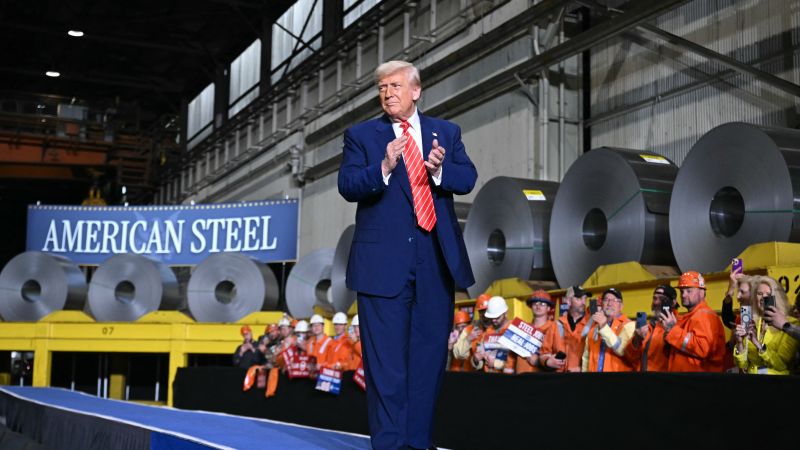
Trump in May demanded a “golden share” of US Steel in exchange for allowing Japan’s Nippon Steel to purchase the company. That gave him a certain level of control over the manufacturer, including preventing layoffs or outsourcing production, no matter the economics.
That’s the same policy American steelmakers – like many US companies – used to object to when describing unfair competition from government-supported businesses overseas.
“The US fought a Cold War against central planning,” Wolfers said.
It’s very possible that now Intel’s overseas competitors will object to the US government’s stake.
Intel said in a filing Monday that 76% of its revenue last year came from foreign countries. Those foreign sales could be hurt since a US government stake means they are possibly subject to “additional regulations, obligations or restrictions, such as foreign subsidy laws.”
The company also warned that the 10% stake could have downsides for the firm since the “US government’s interests in the company may not be the same as those of other stockholders.”
The Trump administration has pushed other companies to act against their own economic interests.
Trump’s Energy Department ordered coal- and gas-burning utility plants, which had been slated to close for fiscal reasons, to remain open. The goal is to support the battered coal industry, which cannot compete with other fuel sources. But clean energy advocates say that comes with a cost for consumers.
Consumers Energy was ordered by the DOE to keep operating a coal-fired plant in Michigan that was set to close in 2025. The company put the price of complying at $29 million for just May 21 till June 30 – a cost it would seek to recoup in higher rates.
“Mandating this half-a-century-old coal plant to stay open will drive up electricity bills and pollution even higher for families and businesses,” said Ted Kelly, director and lead counsel for US clean energy at the Environmental Defense Fund, a public interest group. “Imagine the price shock for ratepayers after several months.”
The utility said the plan to close had been approved in 2022 by numerous stakeholders, including the Michigan Public Service Commission, but that it would comply with the DOE order. Consumers Energy added it would be able to keep operating through higher rates.
Interventionist government policy over business decisions can have wide-reaching consequences, experts say.
Wolfers said the best economic proof of the problem is what happened in North and South Korea in the decades after the war there ended. The two countries had similar land and weather, but post-war, the North Korean economy was driven by central planning while the South relied on market forces.
“Fast forward several decades, and people in North Korea are hungry, they’re an inch shorter than people in South Korea, they’re sicker, they have shorter life expectancy and average income per person is very, very low,” he said. “When you have market forces, you have South Korea, one of the world’s great developing miracles, people are wealthy, healthy and happy.”
“Is Trump Kim Jong Il? Probably not,” Wolfers added. “But the implications are so enormous, that walking down that path could be profoundly economically destructive.”
Other economists warn that the White House directing business operations, not just supporting them, is actually bad for companies in the long run.
The president can “jawbone companies into doing this he wants,” said Scott Lincicome, vice president of general economics and the Stiefel Trade Policy Center at the Cato Institute, a think tank that advocates free market economic policies. But long term that’s likely to result in company operations becoming smaller, less efficient, less effective, less competitive globally.
“They’re using the power of the state alone, whether it’s withholding subsidies or granting tariff exclusions or threatening new tariffs, instead of some sort of direct equity stake,” Lincicome said. “They’re trying to, rather aggressively, dictate corporate decisions in a way that is … certainly more forceful than previous administrations.”
What has many economists particularly worried is not just government intervention in how businesses are run, but how some may feel compelled to publicly please the president.
Whether it be through gifts or merely praise, they say this is a version of “crony capitalism” that stops businesses from being as efficient as they should be.
“The concern is that businesses will seek to get ahead, not through innovation or competition, but by cozying up to Trump,” said Neale Mahoney, professor of economics at Stanford University, adding that such a shift would make the US economy “less dynamic” and the country “less prosperous.”
Earlier this month, Apple CEO Tim Cook provided presented Trump with a customized glass and 24-karat gold statuette. Cook himself theatrically unveiled the item the Oval Office while announcing plans to invest $100 billion in US jobs and suppliers.
Experts say that announcement, and gesture, saved Apple from Trump’s threats of a steep increase in tariffs unless it shifted production of the iPhone back to America.
“I don’t doubt that Trump will get his photo-ops and big-dollar pledges, but I’m less convinced that he’ll get the durable investments that could make a difference for strategically important companies and sectors,” Mahoney said.
[ad_2]
Source link
